

Cromwell P&Z Board Rejects Data Center Moratorium
Planning and Zoning · Meeting of September 24, 2026
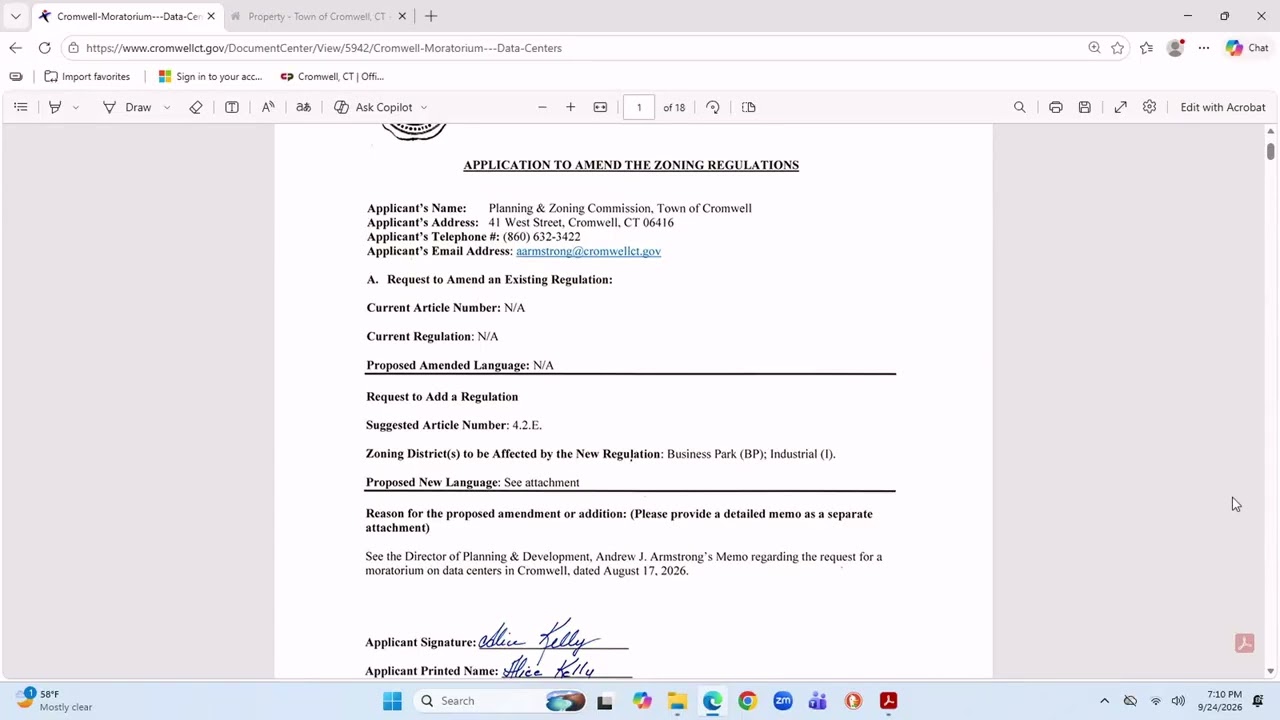
Cromwell Planning and Zoning Commission rejects a one-year data center moratorium after a packed public hearing. The commission voted to reject application 26-25, a text amendment that would have paused data center applications for 12 months, with roughly 40 residents attending and most speakers favoring the pause. Commissioner Ann Grosso said "since all necessary site plan regulations are currently in place, there is no need for a moratorium of any length," while resident Timothy Kropsky countered, "I did not hear any data today to support not going through with a moratorium." Economic Development Coordinator Stuart Popper told commissioners the Economic Development Commission voted September 18 to oppose the moratorium.
The vote to reject passed with one dissent, and Director of Planning Andrew Armstrong was directed to begin drafting data-center-specific zoning definitions immediately.
In the full story:
- Who Was There
- Organizations And Documents Referenced
- The complete report — 2,593 words
Source: the Planning and Zoning meeting of September 24, 2026, reported from the official video recording and transcript.
The Full Article
Roll Call and the Scope of the Hearing
Chair Alice Kelly opened the special meeting at 7 p.m. Thursday with a roll call that included Vice Chair Mike Cannata, Commissioner Andrew Hope, Commissioner Brian Dufresne, Commissioner Ann Grosso and at least one additional commissioner identified on the recording only as "Nick." Director of Planning Andrew Armstrong and a staff member identified as Bruce Driske also attended. Before opening the floor, Kelly stated the meeting's single purpose: a public hearing on application 26-25, a text amendment to Cromwell Zoning Regulation Section 4.2.E proposing a 12-month moratorium on data center applications. She capped each speaker at two minutes per turn and asked residents to state simply whether they favored or opposed the pause, aiming to finish by 9 p.m. The meeting ran well past that mark.
Background and the Disputed Process
The question before the commission was narrow: should Cromwell temporarily bar new data center applications while it studies the industry and updates its zoning definitions? The item traces to an August 17 proposal from a commission member. Armstrong said he drafted moratorium regulatory language the week of August 10-14, sent it to the town attorney on August 14, and received her edits back on August 17 — the same day the item reached the full commission, roughly 28 hours before an August 18 special meeting. That meeting produced a 4-1 vote to schedule Thursday's public hearing.
Several commissioners called that sequence unreasonably compressed. One member, in a lengthy prepared presentation, said the process was "unnecessarily rushed," particularly because a prospective data center company had reportedly been working with unspecified town departments "for six months" to prepare an application that does not yet exist. "I personally do not think that this is an ethical way of treating a potential applicant," the commissioner said, arguing that no applicant should invest months coordinating with staff only to have "the rug pulled out from under them." Armstrong disputed the characterization of delay, noting the commission meets only every two weeks and that he moved as quickly as the town attorney's schedule allowed. "I really don't feel it's rushed," he said, adding that both he and the commissioner disagreed on procedure but remained on good terms personally.
The Regulatory Argument Against a Moratorium
The commission's most detailed intervention came from a member — most likely Vice Chair Mike Cannata, based on an earlier reference by a fellow commissioner to having received "Commissioner Cannata's comments" on the topic — who read the commission's existing site plan regulations into the record at length, citing them by page and section number. He walked through Section 6.F.1.1-4 (promoting health, safety, welfare and harmonious development; ensuring traffic generated by a use won't adversely affect the surrounding area) and Section 8.5, which he called particularly relevant to data centers because it protects "the supply of potable drinking water by protecting and preserving subsurface aquifers." He noted that if a proposed site sits on an aquifer, a separate layer of aquifer-protection rules would also apply.
He also cited Section 6F3.3A, which lets the commission hold a discretionary public hearing on any application it deems significant — meaning, he argued, a special permit process isn't required to guarantee residents a chance to be heard. He read through a full list of site plan review factors on page 175, including traffic and turning-movement impacts, drainage and stormwater management, building shadows, outdoor lighting intensity and direction, noise-generating equipment such as generators, screening and landscaping requirements, and the relationship between a project's taxable value and the municipal services it requires. Page 176 gives the commission authority to require fencing or landscaped screening on any yard, and page 177 allows the commission to impose binding conditions on any approval "necessary to protect the public health, safety, welfare, convenience and property value."
He noted the town's regulations were rewritten in June 2025 by a consulting firm, SLR, after what he called a "disastrous" prior version, and are now undergoing a second review by another consultant under Armstrong, referenced on the recording as "IMEG." He said that review had so far produced only clerical corrections — a characterization Commissioner Ann Grosso echoed in more detail (see below) — and that no substantive gaps had been identified in the site plan section specifically. "Our regulations I think are very concise," he said. "We have the tools in our toolbox to make sure it's done right. We don't need a moratorium to make sure it's done right."
Commissioner Ann Grosso, newly elevated from alternate to full commissioner and describing a background in architecture, agreed the existing framework was adequate. She said she had personally reviewed the "red line" changes proposed by the new consulting firm and found only 23 wording clarifications needed, most of them typographical, against a presentation at the commission's September 15 meeting that had described "over 700 required corrections" to regulations only two years old. "Since all necessary site plan regulations are currently in place, there is no need for a moratorium of any length," she said. Commissioners Andrew Hope and Brian Dufresne both aligned with that view. Hope said he had seen "no evidence of inadequate zoning regulations" and only "general criticisms that appears to be unfounded," while Dufresne said the commission should evaluate any future application on a site-plan basis rather than pre-judge an industry based on national news coverage. A further commissioner, who said she had watched the August 18 meeting remotely rather than attending in person, said she agreed with the emerging consensus among Cannata, Hope, Dufresne and Grosso.
Andrew Armstrong separately pushed back on the framing that the moratorium's purpose was merely grammatical: "It's adding a definition, but it's much, much more than that," he said, describing the moratorium's stated purpose as studying and evaluating data centers broadly and drafting standalone regulations for them, not simply inserting a missing zoning term.
The Case for a Pause
At least two commissioners argued for caution. One, describing feeling like "a steward for the resources and development of Cromwell," said the newness of the technology and its unclear long-term effects on the environment and public health justified waiting. "What the hell do we really know?" the commissioner asked, adding that regulations "can always change" later without cost to the town. Commissioner "Nick" cited having worked inside two data center operations professionally and said reports describe as many as six or seven distinct data center models with differing power, cooling and water needs, arguing the commission needed time — via a moratorium or some other tool — to determine whether existing rules addressed all of them.
Public Hearing: Residents Favor the Pause
Public comment ran long and lopsided toward supporting the moratorium. Timothy Kropsky, a Senator Drive resident and safety engineer at Pratt & Whitney, said the hearing had produced no data justifying skipping a pause: "I did not hear any data today to support not going through with a moratorium." Sean Fisk, of Hillside Road, said he worried the town lacked the resources to evaluate a "hyperscale" data center on its own and wanted a year of transparent study rather than after-the-fact assurances about noise limits. Juan Duque, of Geer Street, said data centers "are not going anywhere" and the town should take the year to research impacts elsewhere before committing. Nicole Gallet, of Freestone Avenue, said the town risked an irreversible industrial footprint on farmland and argued Cromwell would gain nothing from being an early adopter of the technology.
Deirdre Daly, a 75-year resident of Geer Street whose family once owned the farmland at the center of the discussion — formerly Leghorn's Evergreen Nurseries before it was sold to a developer she identified as Gardner — said several Massachusetts towns were already drafting similar moratoriums and Cromwell should do the same research. Alyssa Brande, of High Ridge Road, said she lacked confidence the town's year-old regulations "fully detail the necessary requirements for a large scale or even a small scale data center." Phyllis Becker and Kristen Bishop, both citing Geer Street-area addresses, said the fast-moving nature of the industry meant regulations needed time to evolve. Cara Hapik, of Copper Knoll Lane, said a year would let the commission "gather more data" on water supply, wildlife, heat and electricity impacts before any irreversible land-use decision. Monique Hennessy, of Alexander Drive, urged commissioners to listen to residents who work in the technology field and told them "that's not what your job is" if it meant approving something residents didn't support. Kevin Griffin, of Geer Street, a longtime firefighter, asked that if a moratorium passed, the commission also commission environmental and infrastructure studies and examine what happens to families near any future site "short-term and long-term."
An unnamed 62-year-old speaker, later identified when he approached the podium a second time as John Moran of Geer Street, said his father had worked at a data center decades earlier for a travelers-insurance company and that even with regulations in place, "do we really know what we need to protect ourselves from?" Janice Mooney Frank, of Lincoln Street, said she supported some length of moratorium and asked that the town obtain written confirmation from the water authority on supply capacity before proceeding.
Public Hearing: Mixed and Dissenting Voices
Not all speakers backed a full year. Sonny Lawley, who identified himself as the manager of an existing data center operation at 15 Commerce Drive that has operated in town for more than 15 years, said his company was unrelated to the large-scale "AI data centers" driving the current concern and that six months, not twelve, would be a more appropriate window. Brian Bono, of Court Street, said a full year "discriminates against the businesses that would have applied in that year" and that the town already has tools to evaluate any application. Alan Wilson, of Black Birch Drive, said data centers "don't do anything for the town but generate tax money" while producing heat and emissions, but stopped short of endorsing a full year's delay.
The Economic Development Commission's Position
Stuart Popper, the town's economic development coordinator, told the commission the Economic Development Commission voted at its September 18 meeting to formally oppose the moratorium, concluding the existing zoning regulations already provide adequate protection and require sufficient information from applicants.
Procedural Debate: Site Plan Versus Special Permit
Late in the hearing, resident Kevin Griffin asked whether residents would get a referendum-style say if a data center application ultimately moved forward. Armstrong explained that a site plan approval — the pathway data centers would likely follow — is not automatically subject to a public hearing; that decision rests with the commission's discretion, unlike a special permit, which requires one. Vice Chair Cannata (in the presentation attributed to him above) argued the commission would in practice hold a public hearing regardless, given the topic's high public interest, and that the commission retains authority to impose conditions, including relocating a proposed building, during any site plan review. He also argued for the record that a special permit denial holds up better in court than a site plan denial, since site plan denials are harder to defend on this type of subjective criteria and any denial could be appealed to Superior Court, where a backlog of three to five years is typical.
The Vote and Outcome
After public comment closed, the commission voted first to close the public hearing, then took up a motion described as being made "in the negative" — to not adopt a one-year moratorium on data center applications. The hand vote that followed was momentarily unclear on the recording, with the chair asking members to raise hands after an initial voice vote; the outcome was a rejection of the moratorium with one member dissenting, meaning Cromwell's existing site plan and special permit regulations remain the operative framework for any future data center proposal. Kelly then asked Armstrong to begin drafting strengthened, data-center-specific zoning language immediately, characterizing it as "a request, not a demand." Armstrong confirmed Vice Chair Cannata had separately asked him to do the same. Any resulting text amendment will require its own future public hearing, which staff said will be publicized through the town's website and social media rather than direct mailings, since the item applies town-wide rather than to a single parcel.
Implications and What's Next
The rejection means any company that approaches Cromwell about a data center can submit an application immediately rather than waiting a year, though it will be evaluated under regulations several commissioners themselves described as still under revision. The commission's direction to Armstrong to draft data-center-specific definitions signals the debate is not over: any resulting zoning amendment will trigger a new public hearing, and Thursday's turnout suggests residents will return for it.
Alice Kelly — Chair, presided over the meeting. Mike Cannata — Vice Chair; requested the town planner begin drafting data center regulations. Andrew Hope — Commissioner; opposed the moratorium. Brian Dufresne — Commissioner; opposed the moratorium. Ann Grosso — Commissioner, recently seated from alternate status; opposed the moratorium. A commissioner referred to on the recording as "Nick" — supported considering a moratorium as a tool but did not commit to a position. At least one additional, unidentified commissioner — spoke strongly in favor of the moratorium. At least one additional, unidentified commissioner — aligned with Cannata, Hope, Dufresne and Grosso against the moratorium. Andrew Armstrong — Director of Planning / town planner; managed the hearing's procedural questions and was directed to draft new regulations. Bruce Driske — attended in an unspecified staff or temporary capacity. Stuart Popper — Economic Development Coordinator; presented the Economic Development Commission's opposition to the moratorium. Public commenters (with stated addresses): Timothy Kropsky, 3 Senator Drive; Sean Fisk, 71 Hillside Road; Brian Bono, 77 Court Street; Juan Duque, 73 Geer Street; Nicole Gallet, 1 Freestone Avenue; Deirdre Daly, 63 Geer Street; Alyssa Brande, 23 High Ridge Road; Phyllis Becker, 71 Geer Street; Kristen Bishop, Geer Street area; Cara Hapik, 11 Copper Knoll Lane; Janice Mooney Frank, 44 Lincoln Street; John Moran, 73 Geer Street; Monique Hennessy, 24 Alexander Drive; Kevin Griffin, 67 Geer Street; Sonny Lawley, 6 Winchester Way (also identified as manager of a data center facility at 15 Commerce Drive); Alan Wilson, 9 Black Birch Drive.
Cromwell Zoning Regulation Section 4.2.E — the text amendment provision under which the moratorium application, 26-25, was filed. Cromwell site plan approval regulations, Sections 6.F.1 through 6.F.4 and related pages 174-177 — cited extensively as the existing framework commissioners argued was sufficient to evaluate a data center application. Cromwell Fire District — the quasi-municipal entity that controls and regulates the town's water supply independent of town government; commissioners said it, not the commission, would determine whether a data center applicant could be supplied water. SLR — the consulting firm that conducted a full overhaul of Cromwell's zoning regulations, adopted June 2025. The consulting firm referenced as "IMEG" — engaged after Andrew Armstrong's arrival to conduct a second review of the regulations; described as having made mostly grammatical/clerical corrections to date. Economic Development Commission — voted September 18 to formally oppose the moratorium; presented by Stuart Popper. Pratt & Whitney — employer of speaker Timothy Kropsky, cited for his professional perspective on data-driven decision-making. Email correspondence entered into the record: Nathaniel Palombiano (opposed to data centers), B. Lee and Co. Salon (in favor of the moratorium), Scott Becker (in favor), Mary Wagoner (in favor), Lauren Conroy (in favor), Sean Roche of 9 Jewel Avenue (in favor).